
Be still, be still, my soul; it is but for a season:
Let us endure an hour and see injustice done.”– A. E. Housman, A Shropshire Lad
In some ways, my story begins in El Paso. My mother was born there, during my grandfather’s Army service at Fort Bliss. This has caused innumerable petty arguments in my family about how much the place you were born really matters—her family moved away when she was only eighteen months old, but my mother likes to claim that she’s a Texan just the same sometimes, to the chagrin of my father. Her childhood was spent all over the United States, her family finally setting in Illinois, and she carries few, if any, memories and traits from that time in Texas. My father prefers to say she was born on federal soil, as if this offers a better explanation for her identity. I have heard this argument repeated hundreds of times (usually when the Cowboys are playing the Bears), and while it doesn’t really matter and is never argued with vehemence, it sticks just the same, a low stakes version of a question that under different circumstances would mean life and death: does your place of origin determine who you are?
In other ways, my story begins on far more distant shores. It starts with my great-grandfather, who came with his family from Belgium, seeking work and a better life. It starts with early colonists, who wanted a new chance in the New World. It starts with my paternal grandfather’s parents, who fled the pogroms of Russia and found their way to America with false papers. It belongs, too, to the people who did not “arrive” here: to those who bear my surname in the Yad VaShem database, who were evacuated to the Soviet Union during the Holocaust and who we cannot trace any further, and to those who lived here all their lives. The raspberry farmer, the doctor, the public servant, the nurse, the Catholics, the Jews, and those who were none of those things: all of them offer a beginning of my story, a story noteworthy only because of how totally ordinary it is. Refugees, immigrants, farmers, soldiers—what could be more American than that?
But this particular story begins in El Paso. I came on a work trip: the organization I work for, T’ruah, organizes clergy trips with HIAS, that take rabbis and cantors to the border to show them the conditions there firsthand. Many of these clergy lead communities who are already doing sanctuary work and immigration advocacy: the hope is that they will take the stories of what they saw back home and provide a moral voice on this issue in their communities. I was there simply to help with logistics like food and lodging, but I came, too, because I wanted to see, and because I knew that on my own I would not be brave enough to go.
And indeed, I woke up the first morning of our trip sick with fear. The night before, our itinerary had been explained to us, that we would begin in Mexico and then cross back over to the United States to trace the typical journey of a migrant, but now that the moment had come I worried I wasn’t strong enough to handle it. It was difficult to articulate what I was afraid of—not Mexico, certainly, nor the crossing itself. I’m white and I have a US passport. What was there to fear in that? No, my fear was for my sense of self. What kind of person was I to come and visit these places, then leave again freely? What would the people we were going to visit think of us? Why had my luck given me an upper middle-class background, a passport, freedom of movement? How could I face people who had not been so lucky, and account for myself and my place in the world?
* * *
The crossing itself (by bus) took over an hour, during which I took two calls about our lunch plans and mused at the layered concrete, river, concrete, barbed wire, fence, concrete, another fence, concrete, river, concrete, and fence that constitute the “border,” thinking that perhaps the wall here is sufficient already. As soon as we reached the Mexican side I began to see tents. These belong to Mexican asylum seekers, who are waiting to apply for asylum. Under the new Remain in Mexico policy, most people apply for asylum and then are sent back to Mexico to wait for their case to be heard. However, Mexicans, who are seeking asylum from Mexico, can’t be sent back, and so instead the United States lets them over at the rate of about fifteen per day, to be sent to detention centers or shelters. There are over 3,000 Mexican citizens waiting for those slots and living in tents in Juarez, vulnerable to both crime and the weather.
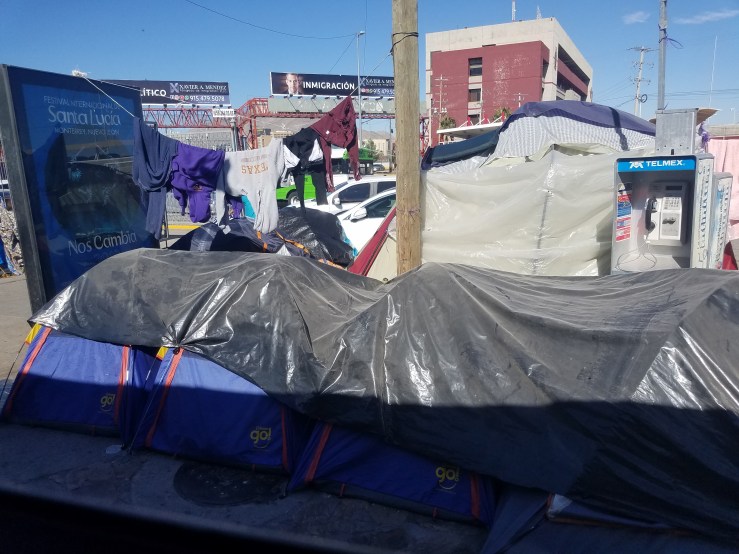
We had no time to stop and visit, however; we were headed to the first federal shelter set up by the government of Mexico to respond to the effects of this new policy. Here there are about 250 beds for some 650 people, 40% of whom are children. They come from all over Central America, fleeing violence and poverty and climate change, and they will be in this shelter for months while they wait for the United States to consider their claims. As we pulled in, people looked up and began to wave.
“We want people to feel welcome and respected,” our guide said as he brought us inside, “so we give them a change of clothes and toiletries when they come. We tell them, get showered and get settled, and we’ll talk about what you need to do tomorrow.”
The shelter served previously as a factory warehouse, and, although much has been done to brighten it a little for the residents, it is still a warehouse—just one that stores people. It is split into four cavernous spaces: sleeping quarters, where residents sleep (children usually in the same bed as their parent) in endless rows of bunk beds; a kind of living space where classes are run for kids during the day; storage, where stacks of toilet paper, clothing, and other supplies reach the ceiling; and the main entryway, where counseling is provided, dinner is eaten, and people find ways to kill the time. Outside, a military food truck, one of only seven in Mexico, works to prepare three meals for all the residents daily. There is school and daycare provided for the children. Some of the residents work during the day. Others do not feel safe going outside: gangs take advantage of the many migrants living in Juarez, and some say they have seen members of the very gangs they are fleeing hanging around the warehouse.
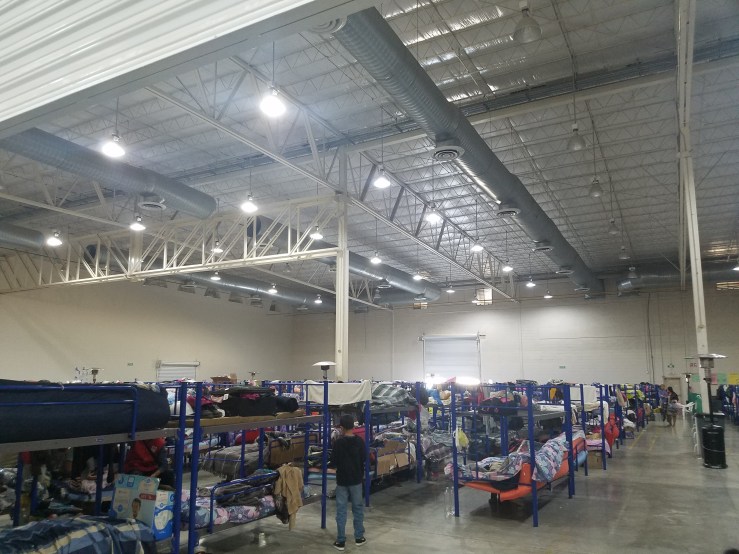
Through the whole tour, we were followed by the residents. The children in particular seemed to want to be seen—they waved, they made faces, and they curled up close to us, hugging us and clinging to our legs. They were dressed like kids across America: t-shirts with Spider Man and Tigger on them, cat ears and puffy headphones. They will be here for months, and they may stay for years. Their parents listened as residents described their reasons for fleeing home, and chimed in with their own stories. We offered them smiles and listening ears, and I wondered how that could possibly be of any help, whether that made our visit worthwhile. And then we boarded the bus and we left.
They are the lucky ones. There are nearly 50,000 people waiting to cross the border, and this is the only federal shelter in Mexico. Two more are set to open in the coming months. Everyone else is out on the street, or in camps.
We waited in line, on foot, on the bridge back for about an hour, where I flashed my passport at a guard midway across (stationed there to prevent people from seeking asylum on US soil) and promptly took another phone call about our lunch, trying to sound professional as I stared at the fences lining the Rio Grande. The actual act of passing into America took less than five minutes: I showed my passport to the guard on the American side of the bridge and put my bag through a scanner and there we were, in the land of the free. I was surprised at the wash of relief I felt. The fear of crossing this border had seeped into me a little, and while I knew, rationally, that no one would deny me entry, it was impossible to believe that it would be as easy as it was. With the relief came a hot trickle of shame—shame that I had been so afraid, that with all my worldly privileges I could hardly stand to see the tents and the shelters for even a few hours.


* * *
The next morning found us on the bus en route to New Mexico, where Otero Detention Center is located, a full forty-five minutes outside of El Paso, in the middle of the desert. Otero is a civil detention center, not a criminal one—the people here, 1,089 men, have not been charged of crimes. Nonetheless, they live behind barbed wire in color-coded prison jumpsuits. They may work, if they wish to: they will be paid one dollar a day. It costs 35 cents per minute to make an international phone call back home. Recreational programming is offered, including ESL, but the participation rate is less than 10%. On the wall, the slogan of the correctional facility: BIONIC, which stands for “Believe It Or Not, I Care.” Flyers tacked to bulletin boards bear titles like, “Are you detained and separated from your child(ren)”? The text continues, if you believe that your separation from your child was improper…
The people we saw at Otero were generally proud of their work, explaining that ICE doesn’t require recreational programming, and that they process people into their facility in about 12 hours, instead of the mandated 48. They told us that while they use solitary confinement, it is generally for people who don’t feel safe in the general population, or for people who “prefer to be alone.” They told us that the food was good, and that dietary restrictions were accommodated. This has all been directly contradicted in reputable news sources by attorneys and the detainees themselves: vegetarian residents have been on a hunger strike; some detainees have reported that the food is rotten; Cuban asylum seekers have attempted suicide. In all cases, those who spoke up were placed in solitary confinement as punishment, for up to 29 days. Under international law, more than 15 days in solitary confinement is considered torture.
In spite of their pride, I noticed too an abdication of responsibility—so many of the questions we asked were answered with “I don’t have that information, but I can find it; I can get it” or “that’s not my area to know that, you’d have to ask the ICE officer,” and so on. These people have been in the system for decades, starting work in correctional systems at age 18 or 19, and they will tell you that they are just doing their jobs, just bringing home a paycheck. Centers like Otero bring business and jobs to areas that didn’t have them before. It is hard to tell whether the staff know that the people they are holding in prison conditions have not committed any crimes.
As in the shelter, however, seeing the detainees themselves was the hardest part. It was hard to know to do—to wave, to smile, to nod? One rabbi just made eye contact and put his hand over his heart, a gesture I could never manage to do as sincerely and warmly as he did, but I was glad he was there to do it. In the end, I settled for a mixture—nodding, smiling, waving, and murmuring “Buenos dias” to those we passed. The rest of the day, I saw their faces when I closed my eyes. What will happen to them?
Most likely, their asylum claims will be denied, and they will be deported. Immigration judges in El Paso all have denial rates in the 90th percentile, including one judge who has never accepted an asylum claim during his tenure on the bench. “I love El Paso,” a lawyer told us later on our trip, “but when we get someone released, the first thing we tell them is ‘get the hell out of here.’” If you come to New York, your chances of being granted asylum increase by almost 900%.
We visited the courts later that afternoon, to watch four men on trial for the crime of crossing the border without documentation. This is different from their immigration pleas—the judge was here only to mete out punishment for their crime of illegal crossing. The men were all in shackles, and hooked up to electronic translators so they could understand what was happening. They all pleaded guilty. One man had crossed over illegally just two weeks before, and when the judge asked him why he would do such a thing again so soon, he said simply, “Mi familia.” My family, he answered, my children. He had lived in Dallas for the last 12 years; his wife and his children are there. The judge sentenced him to 30 days and warned him that next time he would not be so lucky.


* * *
There were many moments of hope on our trip, too. We met with Annunciation House, an incredible organization that almost single-handedly housed migrants during the Catch and Release program (Remain in Mexico’s predecessor), during which thousands of migrants were released to the streets of El Paso every night. Now they house anyone ICE releases to them, as well as undocumented immigrants and those who need to stay in the United States for a certain amount of time to collect Social Security checks. We met with Las Americas, an advocacy center that provides pro bono aid to hundreds of migrants. We met with faith-based organizations, city representatives, and ordinary citizens, all trying to do the very best they can to help mitigate a horrible situation and to provide these people with the hardest thing of all: a sense of dignity, a feeling that their humanity is seen, valued, and respected.
But it was hard to hold onto that hope. The people we met with were tired, and they all had dark stories of their own to share. They’re constantly revising their strategies as the rules coming down from the administration change, and they don’t know what to prepare for next. They told our group (perhaps because they were clergy) that while legal and advocate voices are firm, there is a lack of moral leadership at the border. In their own community? In the national community? In the international community? It was hard to tell.
As much as the policies at the border are, in a twisted way, sort of “working” (they’re deterring people from coming, anyway), this issue is connected to all the other ones we’re grappling with right now—with climate change, with systemic racism, with mass incarceration, and on and on. Moral leadership on this issue needs to respond to more than just the simple question of whether it’s right to force people to wait in another country while they seek asylum, it needs to answer the question of who, as Americans, we want to be. What is our American experiment really about? Are we still dedicated to the proposition that all men are created equal? Are we still dedicated to freedom of religion, freedom of speech, freedom from want, and freedom from fear? How much do our words and our aspirations matter, when our deeds reflect something so different?
As a lover of reading, I have always believed that words matter, but I do not submit this love as the proof that they do: rather, I will offer up the 50,000 people camped outside our border, who believe so strongly in our four freedoms that they will risk any humiliation and danger we put them through to enjoy them. They keep coming, despite the mass shootings and the income inequality and the bigotry, because an American passport is one of the most powerful documents in the world. They keep coming, because whatever we have to offer them is better than what they are leaving behind. Some have lives here—my family, my children. Some wish only the chance to build a life where they are a little less afraid. And just across the Rio Grande, the city of El Paso stands ready to welcome them and to help them however they can. In that, there is hope.
* * *
On the side of Las Americas’s building in El Paso, there is a mural with a painted quote from President Franklin D. Roosevelt: “Remember, remember always, that all of us, and you and I especially, are descended from immigrants and revolutionaries.” I remember, although this memory is a complicated thing. Not all Americans came to these shores seeking a new life, for some were brought in chains. And not all Americans “arrived” at all—innumerable Americans were murdered for the crime of being here when Europeans first came to discover them. This is a land built on slavery and on genocide as much as it is on self-evident truths and the struggle for freedom. But I believe that the place we start should not, cannot, does not determine the place we end up. We will not learn or grow from washing our hands of the American experiment, from gathering our results and deciding the whole enterprise was a failure. We have everything to gain from struggling forward—granting just one more person asylum, bringing one more family back together. That’s how my family made it in America. That’s how millions of families made it in America. That used to be something we were proud of.
America’s immigration struggles may be on full display in El Paso, but this problem belongs to all of us. One after another, the people we spoke with emphasized this: divided as our country may be, this is not just a border town issue. It’s not a Democrat’s issue, or a Republican’s issue. It is a question that belongs to everyone living in this country, for while we did not choose to be born here, we can choose what we will make of that privilege. How will we respond? What will it take to make us care? What kind of country do we want to be?
—
Title taken from T. S. Eliot’s “Ash Wednesday.”
The following organizations, all of which we met with, are doing direct-service work on the ground, providing desperately needed aid in what is an increasingly dire situation. All welcome financial donations, and many also take volunteers. You can find out more about them on their websites:

 Bare the Iron Hand
[…] https://baretheironhand.blog/2019/11/08/teach-us-to-care/ […]
LikeLike